Author: EMBRACE Team
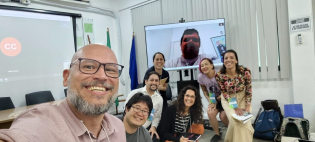
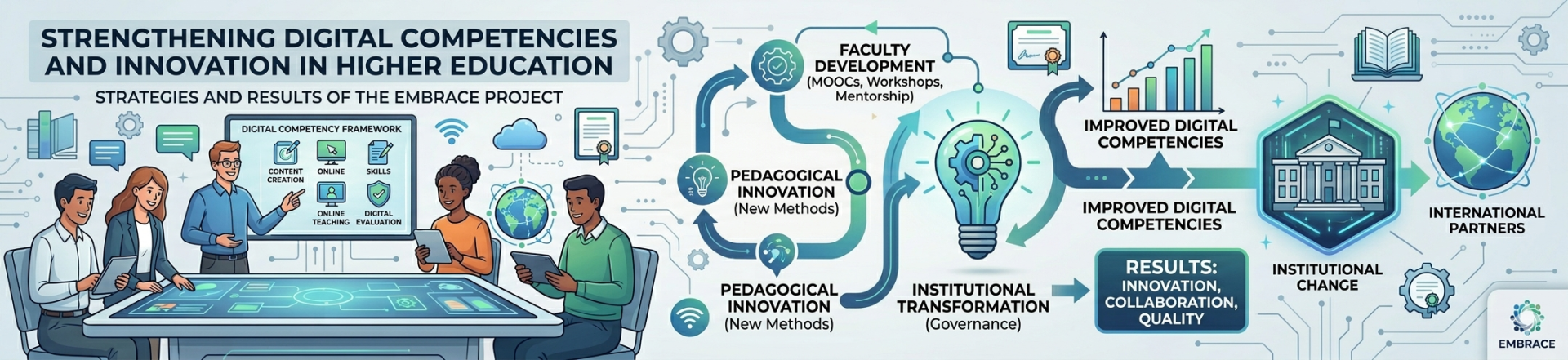
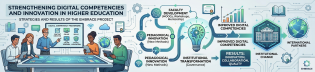
This report presents the design and implementation of strategies to strengthen digital competencies and institutional innovation within the EMBRACE project. It highlights collaborative approaches, capacity building, and systemic transformation across partner institutions, fostering sustainable digital education and enhancing academic and professional practices.
Read more
Author: EMBRACE Team
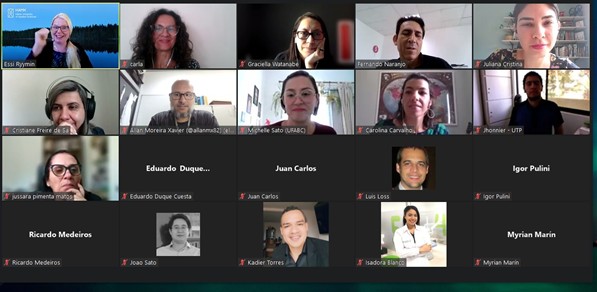
This report presents the development of collaborative learning ecosystems within the EMBRACE project, focusing on university–industry cooperation. Through workshops, mentoring, and pilot initiatives, partner institutions designed and implemented innovative models that enhance skills development, foster co-creation, and strengthen connections between academia, industry, and society.
Read more
Author: EMBRACE Team
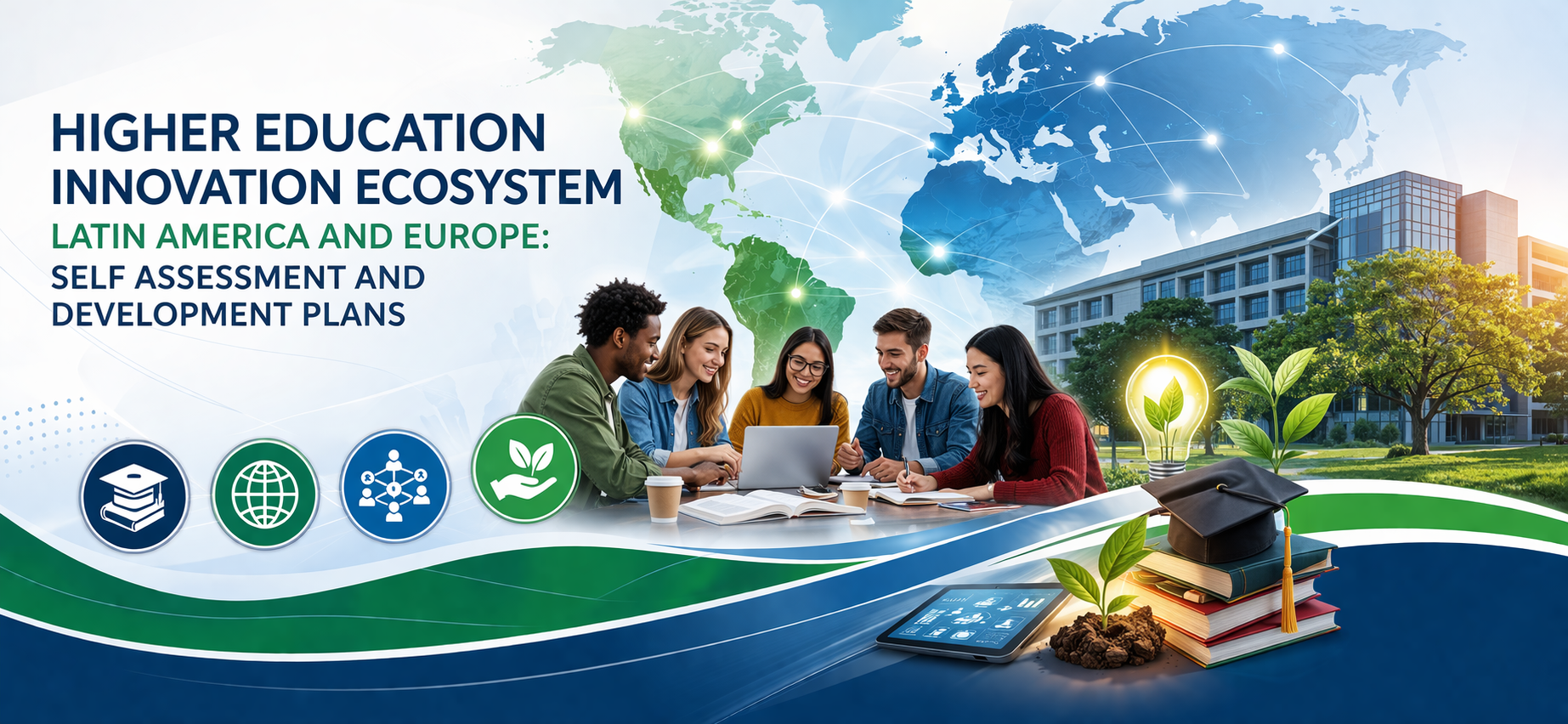
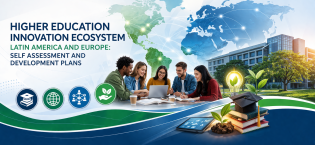
This study examines how higher education institutions in Latin America and Europe assess and develop innovation ecosystems through participatory self-assessment. Findings reveal shared challenges, contextual differences, and strategic priorities, highlighting universities’ evolving role as key drivers of collaboration, inclusion, and sustainable innovation in complex educational and societal environments.
Read more

This paper explores the use of generative artificial intelligences to create dynamic tests in formative assessments. Through personalized quizzes, immediate feedback is facilitated, allowing the teacher to adjust his or her teaching in real time. This innovative methodology improves students’ understanding, catering to their individual needs and fostering deeper and more meaningful learning.
Read more
The EMBRACE project, funded by EACEA, focuses on modernizing higher education by enhancing teacher training in digital pedagogy, integrating CLIL and ePedagogy approaches. Through international collaboration and active learning strategies, UFABC participants developed digital competences and adapted global practices to local needs, emphasizing inclusion, accessibility, and student-centered methodologies for lasting educational transformation.
Read more
The enhancement of teaching and learning activities is a central objective in contemporary education, especially in the context of the digitisation of information. In this context, digital teaching strategies promote a learner-centred process when properly managed and thought through by significantly enhancing the learning process.
Read more
Competency-based training is based on identifying these key skills and designing educational programs that help students acquire them and apply them in practical situations.
Read more
The emergence of Artificial Intelligence based on usage models, such as the recognition and generation of texts, contexts and images based on simple questions.
Read more
With more than four thousand students, preparing for the job market is just one of the institution’s functions.
Read more
This article explores AI-assisted digital teaching through the lens of digital dialectics. It highlights how human-AI interaction can foster critical thinking, argumentation, and knowledge construction, while warning against cognitive sedentarism. Emphasizing ethical use, it presents AI as a human extension that should support—not replace—deep, reflective learning.
Read more
This article reflects on the collaborative creation of MOOCs by Colombian and Brazilian universities within the EMBRACE project. It highlights intercultural teamwork, pedagogical reflection, and the transformative power of international cooperation in digital education. Language differences became bridges, fostering inclusive, participatory, and meaningful learning design for diverse contexts.
Read more
The project, entitled EMBRACE: “Education Modernization Brazil, Colombia, Europe – the new era of digital higher education cooperation”, was approved under the ERASMUS-EDU-2022-CBHE call, Development of Competences in the Field of Higher Education, Axis 2: Partnerships for Transformation in Higher Education.
Read more
EMBRACE is an international podcast about innovation and digital transformation in higher education, analyzing the impact of technology, artificial intelligence, and global cooperation on the modernization of teaching and the development of 21st-century skills.
Read more
UFABC is a Brazilian federal public institution of higher learning based in Santo André and São Bernardo do Campo, municipalities belonging to the ABC region, both in the state of São Paulo.
Read more
The IPB is a public institution of higher education, committed to providing quality training and promoting research and extension activities with an impact on the economic, social and cultural environment.
Read more
This study examines how higher education institutions in Latin America and Europe assess and develop innovation ecosystems through participatory self-assessment. Findings reveal shared challenges, contextual differences, and strategic priorities, highlighting universities’ evolving role as key drivers of collaboration, inclusion, and sustainable innovation in complex educational and societal environments.
Read more
This report presents the design and implementation of strategies to strengthen digital competencies and institutional innovation within the EMBRACE project. It highlights collaborative approaches, capacity building, and systemic transformation across partner institutions, fostering sustainable digital education and enhancing academic and professional practices.
Read more
EMBRACE is a project led by Häme University of Applied Sciences (HAMK) to which several institutions from Brazil, Colombia and Portugal have joined, with the idea of looking to the future and supporting the modernization of higher education.
Read more
Collaborative book outlining digital competency frameworks, policies, and institutional practices to support higher education teachers’ digital pedagogy in Latin America.
Read more
The EMBRACE Professional Development Program enhances digital and pedagogical skills of higher education teachers in Brazil and Colombia, addressing gaps exposed by the COVID-19 pandemic. The initiative promotes teacher training, inclusive digital learning, and collaboration with the European DigCompEdu framework. Initial feedback highlights the program’s rich content, accessibility challenges, and its potential for transformative educational change.
Read more
IFSP is a multi campuses pluri-curricula higher and professional education institution.
Read more
The EMBRACE project promotes institutional transformation in higher education through teacher training in digital and pedagogical skills. It develops MOOCs to foster innovative, inclusive learning ecosystems aligned with labor market and societal needs. Partner institutions from Brazil, Colombia, Portugal, and Finland collaborate to address complex local and regional challenges.
Read more
The digitalization of work demands stronger ties between universities and industries, emphasizing collaboration, transversal skills, and innovative ecosystems to prepare students for the evolving future of work.
Read more
At HAMK, studying is a team effort – both with other students and with partners. As a student, you’ll get to solve real-life problems right from the start of your studies.
Read more
The article highlights the importance of continuous teacher training, using Finland and the international EMBRACE project as examples. The initiative promotes inclusive and collaborative learning ecosystems in Brazil, Colombia, and Europe, fostering teacher development through technology, internationalization, and co-creation tailored to diverse contexts.
Read more
Thus, the following sections present actions coordinated by the researchers, such as training courses, workshops and events, which culminated in the approval of the international research project Erasmus Capacity Building Higher Education “EMBRACE – Education Modernization Brazil, Colombia, Europe – the new era of digital higher education cooperation, valid from 2023 to 2026, in which, in addition to UFABC, other Higher Education Institutions (HEIs) from Brazil, Finland, Portugal and Colombia participate.
Read more
Felipe Baena, Sectional Rector at Areandina, and André Romero da Silva, Dean of Research and Graduate Studies at IFES, share their perspectives on the Embrace Project.
Read more
The article explores how the design of cognitive activities based on Bloom’s Taxonomy, combined with technological tools, transforms learning. It sets clear and measurable objectives at each cognitive level, from basic comprehension to critical evaluation, encouraging dynamic learning aligned with desired competencies.
Read more
The present essay proposes a reflection on the contributions of qualitative principles in research to be developed in the field of Instructional Design, aiming to contribute to the proposition of new methodological approaches.
Read more
From the CRIE, the UTP invites teachers to enroll in the MOOC Digipeda – Digital and Pedagogical Competencies, starting in October 2024. They will not only be able to strengthen their digital competencies, but also share and exchange ideas and experiences with teachers from Brazil.
Read more

Technology has transformed education by democratizing access to knowledge, personalizing learning, and promoting new methodologies such as the hybrid model. Despite its benefits, it requires teacher training and attention to challenges like privacy and digital dependency to ensure effective and equitable integration.
Read more
The EMBRACE project demonstrates significant impact in digital transformation, teacher competence development, and institutional collaboration. Using a mixed-methods evaluation, it reveals systemic change across partner institutions, strengthening governance, learning ecosystems, and international cooperation, while generating measurable socio-institutional value and fostering sustainable innovation in higher education.
Read more
This article examines how the EMBRACE project builds professional learning communities in higher education, fostering collaboration, digital pedagogy, and institutional transformation. It highlights achievements, challenges, and strategies to strengthen teacher development, innovation, and sustainable partnerships between academia and society.
Read more
The Technological University of Pereira is a public institution of higher education accredited with high quality in several of its undergraduate and graduate degrees.
Read more
The EMBRACE project MOOCs involved UFABC teacher tutors who evaluated and improved content to ensure academic quality. They praised the variety of materials and digital tools but noted challenges in language integration, assessments, and Moodle navigation. Their feedback will help refine future editions.
Read more